
There’s a specific kind of problem that only growing food brands get to have: too much demand. Orders are climbing, a retailer just asked about expanding your shelf space, and the co-packer that got you this far is starting to creak under the weight of your success.
It’s a good problem. But it’s still a problem, and how you solve it determines whether the next chapter of your brand is one of smooth growth or constant firefighting!
Bringing on a co-packer was the right move when you made it. It freed you from running your own production line and let you focus on building the business. But co-packing partnerships aren’t one size fits all, and the partner that suited you at one stage can quietly become the thing holding you back at the next. The hard part isn’t deciding whether to make a change. It’s recognizing when.
Here are five signs the moment has arrived.
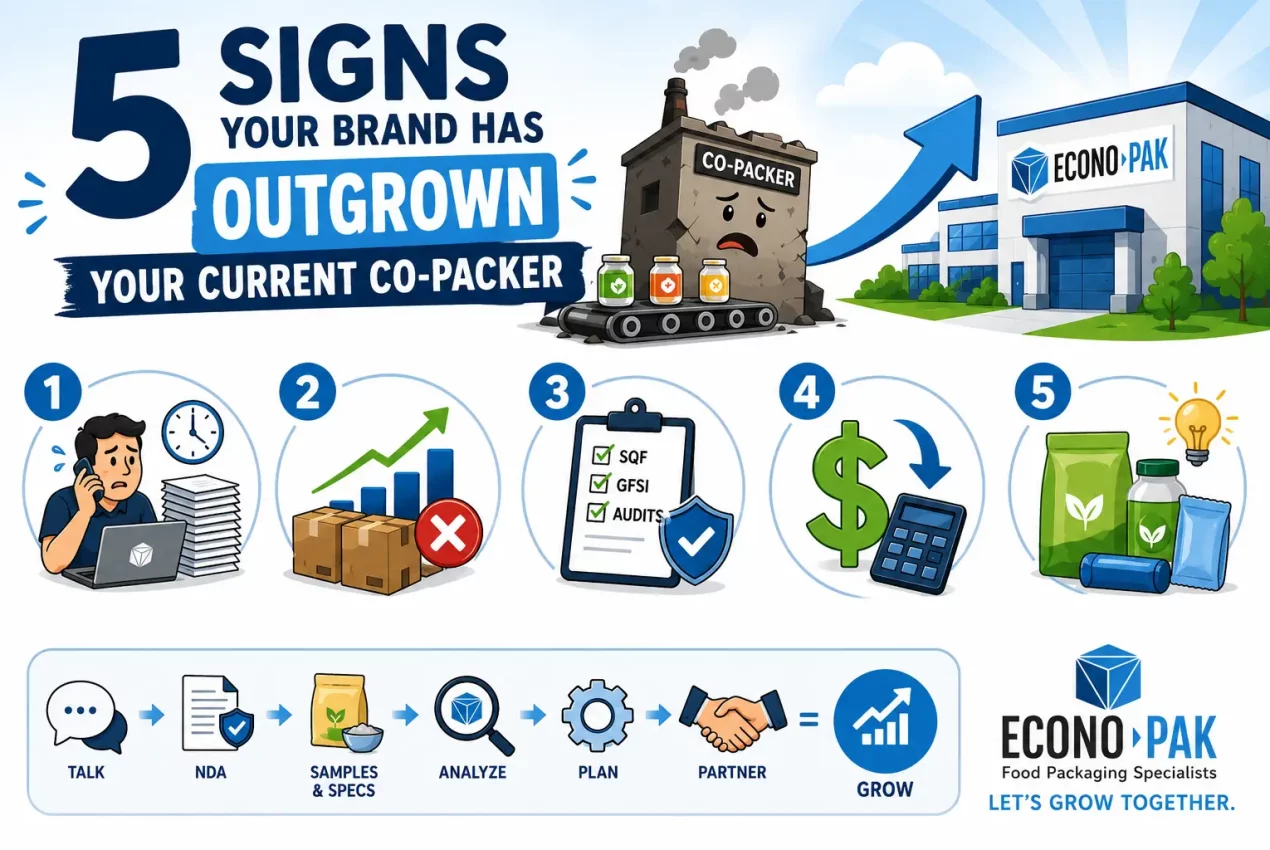
1. You’re spending more time managing your co-packer than growing your brand
A good co-packing relationship should give you time back. If instead you find yourself constantly chasing updates, double-checking quality, smoothing over missed deadlines, or explaining the same requirements again and again, the partnership has flipped from asset to liability.
Every hour spent babysitting production is an hour not spent developing new products, landing accounts, or building your brand. When managing your co-packer starts to feel like a second job, it’s a sign you’ve outgrown them.
2. Demand is outrunning their capacity
The clearest signal of all: your co-packer can’t keep up. Maybe a distributor wants volumes they can’t hit. Maybe seasonal spikes leave you scrambling. Maybe lead times keep stretching and shelves sit empty while you wait.
A co-packer that was perfectly sized for you two years ago may simply not have the floor space, equipment, or throughput to support where you are now. Turning away revenue because your partner has maxed out is the textbook case for finding one with real high-volume capacity, the kind built to scale up as your demand increases.
3. Retailers are asking for things your co-packer can’t provide
Moving into bigger retail is a milestone, and a stress test. Big-box and national chains don’t just want product. They want certifications, audit trails, consistent specs, and reliable fulfillment at scale. Requirements like SQF or GFSI-recognized food safety certification, allergen and gluten management programs, and retailer-specific audits aren’t optional at that level.
If your current co-packer can’t meet those standards, they can cost you the very accounts you’ve worked so hard to win. A facility that’s already SQF Level 3 certified, FDA-compliant, and independently audited for major retailers lets you say yes to those opportunities instead of watching them slip away.
4. The relationship stopped making financial sense
Pricing, minimums, and flexibility all matter, and they all change as you grow. The cost structure that worked when you were smaller may no longer fit. Maybe your minimums are forcing awkward production runs. Maybe pricing hasn’t scaled with your volume. Maybe hidden inefficiencies are quietly eating your margins.
As your order sizes grow, the right partner should help your per-unit economics improve, not stall. If the numbers have stopped working in your favor, it’s worth seeing what a better-matched co-packer could do for your bottom line.
5. You want to grow your product line, not just your volume
Scaling isn’t only about making more of the same thing. Maybe you want to launch new flavors, move into variety packs, add seasonal SKUs, or reformulate with new ingredients. If every new idea runs into “we can’t do that here,” your co-packer’s limits have become your brand’s limits.
A full-service partner with broad capabilities, including filling, bagging, seasoning and blending, repackaging, variety packs, and shrink wrapping, lets you experiment and expand without re-tooling the whole operation each time. Your creativity should be limited by your imagination, not by your co-packer’s equipment list.
What switching co-packers actually looks like
If a few of these signs feel familiar, the next step is simpler than you might expect. A good co-packing partnership usually starts with a conversation about your product and your goals, followed by an NDA to protect your recipes and proprietary information. From there, you send samples and specs, the new co-packer’s team analyzes how your product runs on their equipment, and together you settle on the right packaging formats, materials, and quantities for your shelf life and your market.
The right partner doesn’t just execute. They bring decades of know-how to help you avoid the costly missteps that come with a poorly managed transition, so the handoff is smooth and your customers never feel the difference.
The bottom line
Outgrowing a co-packer isn’t a failure. It’s a sign you’re winning. The brands that scale well are the ones that recognize the moment and move to a partner built for where they’re headed, not where they’ve been.
If you’re seeing these signs in your own operation, it may be time to make a change. At Econo-Pak, we’ve spent over 40 years helping food brands, from fast-growing challengers to Fortune 500 names, scale up smoothly with high-volume, retailer-ready contract packaging out of our 325,000 square-foot facility. When you’re ready to grow, we’re ready to help.
Let's start scaling.
Is your demand outpacing your ability to package your own product? Then consider outsourcing with Econo-Pak.
With over 40 years of experience working with both small brands and Fortune 500 companies, we are capable of handling your specific dry food product.
Get in touch with our team for a fixed-price quote for your project.