
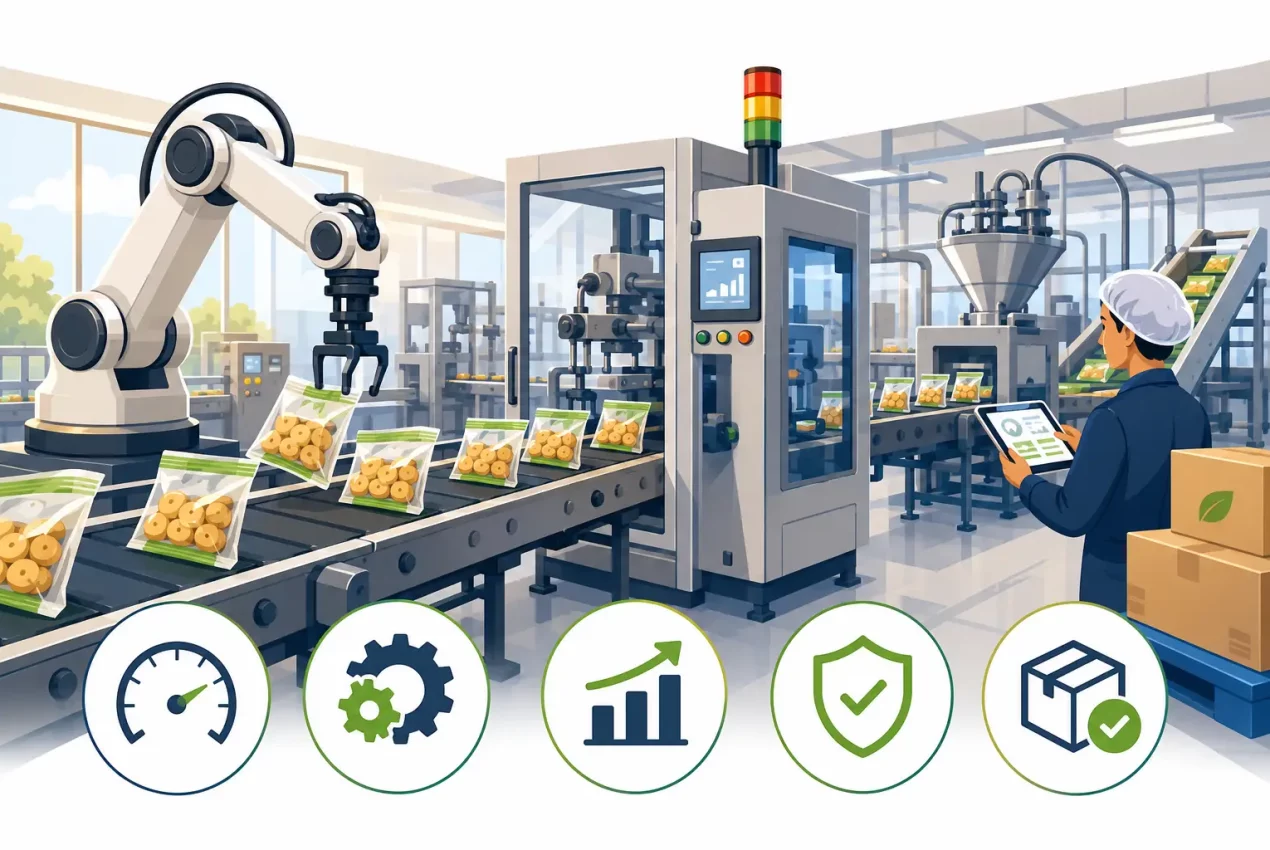
Food brands rarely lose shelf space because of a bad product. They lose it because they could not fill an order on time. As retail demand grows and consumer expectations rise, the difference between a brand that scales and a brand that stalls often comes down to one thing: the technology behind the packaging line.
Packaging automation is no longer a luxury reserved for Fortune 500 manufacturers. It has become a baseline requirement for any company that wants to compete in high-volume food packaging. The question for most growing brands is not whether to automate, but whether to build that capability in house or partner with a contract packaging company that already has it.
What Does Automation Actually Solve?
Manual and semi-automated packaging operations carry hidden costs that show up long before anyone reviews a budget. Labor availability remains tight across the food manufacturing industry, and every open position on a line translates directly into lost throughput. Automated packaging equipment reduces that dependency and delivers consistent output shift after shift.
Speed is the obvious benefit, but consistency is the more valuable one. Automated vertical form fill seal machines, checkweighers, and vision inspection systems produce the same result on the ten thousandth unit as they do on the first. That repeatability protects fill weights, seal integrity, and product quality, which in turn protects your relationship with the retailer.
Automation also improves food safety. Fewer touchpoints means fewer opportunities for contamination, and modern equipment is designed for faster sanitation and cleaner changeovers between runs.
Why Standing Still Is the Riskiest Choice
Packaging technology moves quickly. Formats that were niche five years ago, including single serve portions, or recyclable mono material films, are now standard requests from major retailers. Equipment that cannot run those formats limits what a brand can sell.
There is also a growing data gap. Newer packaging machines capture real time production data on downtime, efficiency, and yield. Operations still running legacy equipment are making decisions on estimates while their competitors are making decisions on facts. Over a year, that difference compounds into meaningful cost and margin advantages.
Sustainability pressure adds another layer. Thinner films, alternative substrates, and reduced secondary packaging all require machinery capable of handling them. Committing to sustainable packaging without the right equipment to run it is a promise most operations cannot keep.
The Real Cost of Delaying Capital Investment
Packaging equipment is expensive, and that reality causes many companies to postpone upgrades. The problem is that the cost of waiting is quieter but not smaller. It shows up as overtime, excess scrap, missed purchase orders, expedited freight, and eventually as lost accounts.
For emerging and midsize brands, the math is even harder. Building an automated packaging line in house requires capital, floor space, maintenance staff, and technical expertise that most food companies would rather invest in product development and marketing. This is exactly why so many brands turn to a contract packaging partner instead.
How Econo-Pak Approaches Automation
Econo-Pak has spent more than four decades building an operation around this principle. As a third generation family owned contract packaging company, we reinvest continuously in modern equipment rather than running machinery until it fails.
Our facility operates more than 200 packaging machines across formats that include bagging, pouching, single serve packaging, shrink wrapping, variety packs, and shipper displays, supported by in house blending, seasoning, and grinding capabilities. Our recent expansion has added significant production capacity, giving our clients room to grow without renegotiating their supply chain.
That investment is paired with the standards food brands require. Econo-Pak is SQF Level 3 certified and FDA registered, with certifications that include Kosher and USDA Organic.
The result is straightforward. Our clients get access to advanced packaging automation, technical expertise, and high volume capacity without carrying the capital cost themselves. They focus on building their brand. We handle getting it packaged, compliant, and out the door.
If your demand is outpacing your current packaging capabilities, Econo-Pak can help. Complete your RFQ today to get the conversation started!
Let's start scaling.
Is your demand outpacing your ability to package your own product? Then consider outsourcing with Econo-Pak.
With over 40 years of experience working with both small brands and Fortune 500 companies, we are capable of handling your specific dry food product.
Get in touch with our team for a fixed-price quote for your project.